Waterline
ARCHITECTURE(S) OF WATER
Immerse yourself in water architecture and its artistic languages!
DID YOU KNOW?
Does Porto's water architecture have its own identity and form part of international artistic movements?
THE CENTRALS
The central steam plant was built to transport water from its source, which could now be chosen for its quality rather than its proximity, to the city. The Cornish engine that made this industrial system possible was developed in Cornwall in 1812 and was used by plants in the 19th century. A preserved example can be found in the Lyon Plant museum. The Lyon Power Station, or Usine des eaux de Lyon-Saint-Clair, was also built by the Compagnie Générale des Eaux, the company responsible for the Porto system, which explains the similarity in architectural style with that of Lyon.
The waterworks style is characterized by classicist influences, where round arches predominate. The plants inherited by SMAS, from the first domestic water supply system in the city of Porto in the 19th century, bear witness to this architectural language that spread from the 1850s onwards. In the case of Porto, the plants are rectangular in plan, with a single nave, with round arches that open onto the elevations with rusticated corners, vaulted roofs with oculi, and accompanied by a chimney. The plants were the central architectural element of an industrial complex consisting of the plant and chimney, an element that was introduced in cities from the middle of the century onwards with the function of controlling the pressure of steam machinery. The Sousa Plant and the Santo Isidro Reservoir are examples of this chronology and architectural style. The Sousa Power Station is larger in scale and was the central element of the system, as in addition to being a pumping station, it was also designed to capture and filter water. For this reason, the Sousa complex also consists of filter galleries and a weir to regulate the river's water level.
-
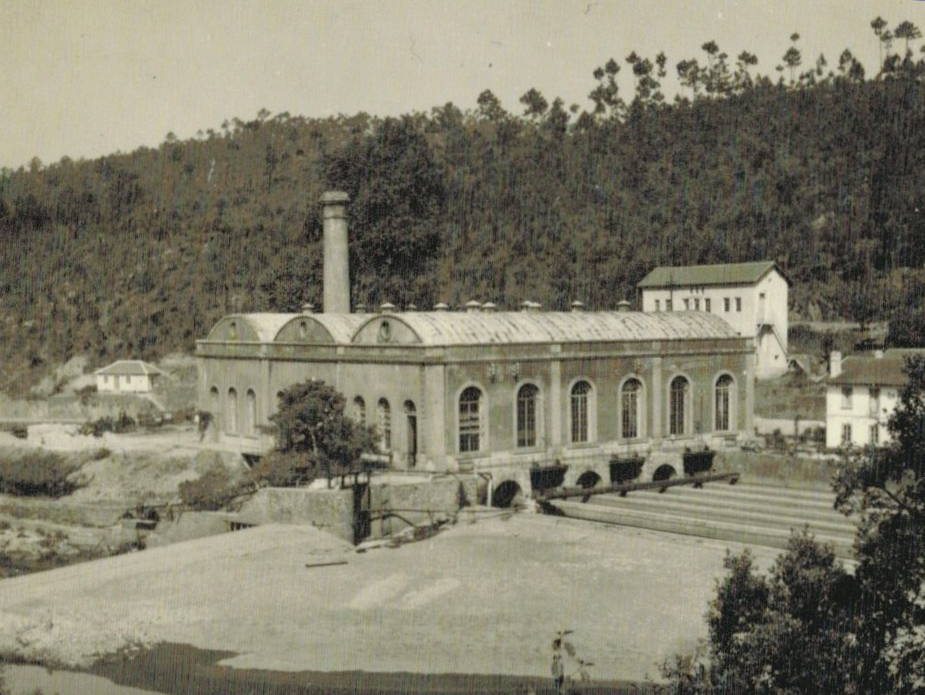
Foz do Sousa Water Collection, Filtration, and Elevation Plant (1886) in 1939, AEdP Historical Archive.
-
![Santo Isidro Power Plant, [n.d.]. AEdP Historical Archive.](/imagens/galeria/slideshow_145_2.jpg)
Santo Isidro Power Plant, [n.d.]. AEdP Historical Archive.
The Nova Sintra Central, built in the early 20th century, belongs to a new phase in the history of water supply, the modern supply phase that began in 1920. This new phase is characterized by the abandonment of steam machinery in favor of electric machinery, which influenced the architecture of the plants. Electric machinery was more compact and the need for large-scale architecture no longer made sense, resulting in smaller or even underground plants.
-
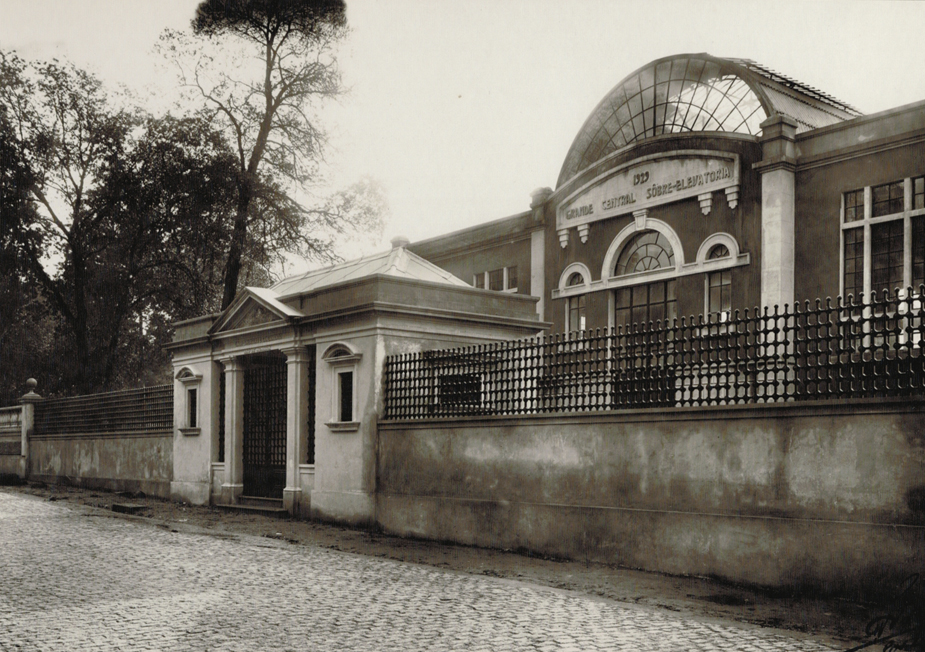
Nova Sintra Power Station, 1929. AEdP Historical Archive.
THE RESERVOIRS
Industrial reservoirs were created in the 19th century and introduced into urban planning, integrated into domestic water supply systems, made possible by steam engines. The first reservoirs to be built in Porto were part of the first domestic water supply system. There were three of them – the Santo Isidro Reservoir, the Monte dos Congregados Reservoir, and the São João da Foz Reservoir – consisting of two tanks and a control chamber, and they were underground, with the exception of the Monte dos Congregados Reservoir. The control chamber was a building attached to the reservoir where the pipes and water were managed, and its architectural structure was replicated in the three reservoirs: three vertical registers, the central one protruding, topped with an architrave with a projecting cornice and national coat of arms, with three round arches and rusticated corners, and a staircase leading to the center with an iron gate. Inside, there were iron columns with vegetalist capitals and tile cladding on the floor and walls.
It was only later, in the 20th century, that Porto received its first industrial tower reservoir, a type of structure that became widespread in Europe in the second half of the 19th century and whose function was to store water and regulate water pressure in the system. In 1937, the Congregados Tower Reservoir was designed, followed later, in the 1970s, by the Amial and Fonte da Moura reservoirs.
-
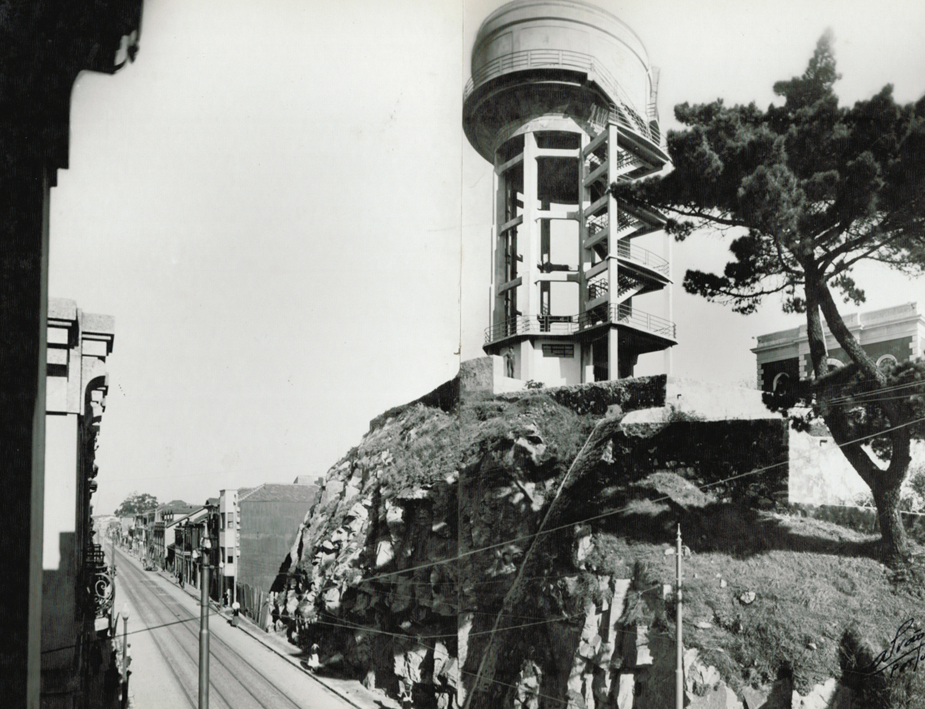
Congregados tower reservoir, 1938. AEdP Historical Archive.
THE FONTES D’ART
The concept of Fonte d'Art was created in the second half of the 19th century, based on the new industry that combined art with industry—sculpture and casting—producing mass-produced and accessible urban artifacts. In Porto, it was part of the urban improvement and development projects carried out throughout the century and within the scope of the 1865 Universal Exhibition, which expanded, enlarged, and beautified the city. The artistic casting industry was established at the 1867 Universal Exhibition, where for the first time there was a specific class of “Bronzes d'art, Fontes d'arts diverses, objets en metaux repoussés” (artistic bronzes, various artistic fountains, embossed metal objects). But it was in 1878 that the fountain art industry became established in the field of urban beautification. Most of the pieces in Portugal were manufactured by the Val d'Osne and Durenne foundries. This new industry was characterized by rapid production, using molds, and the affordable price of cast iron. One of the characteristics of 19th-century street furniture is, therefore, its democratization. It can be considered as unifying the urban space, where catalogs functioned as image diffusers, as we saw happen with engravings in previous chronologies.
-
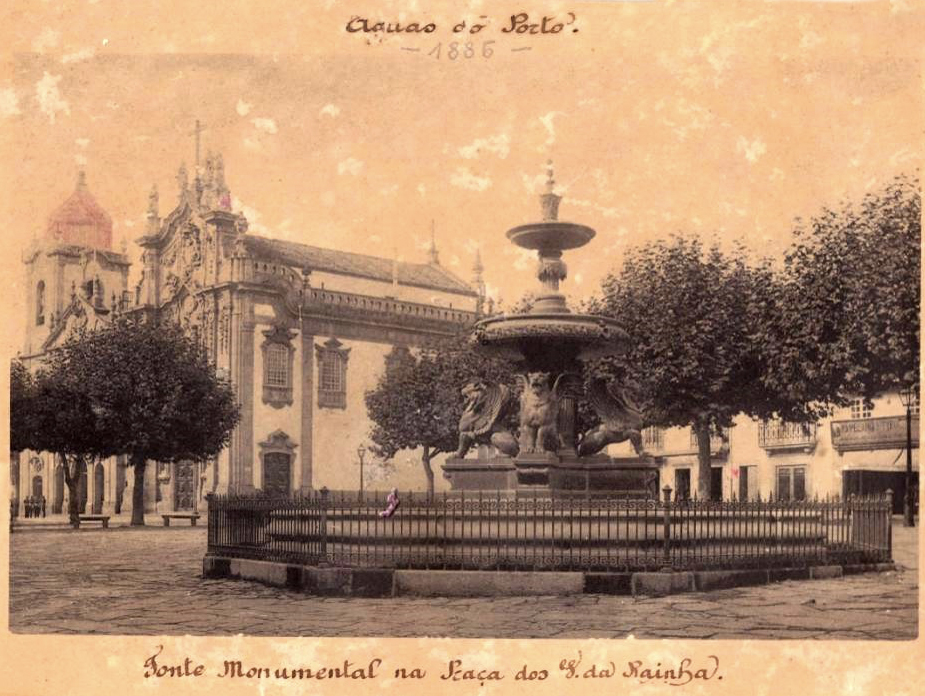
Monumental Fountain, 1886. Historical Archive of the AEdP.
The city of Porto has examples of this artistic context, produced in the most emblematic foundries in Paris, such as the fountains in the Crystal Palace Gardens produced as part of the Crystal Palace project, the Ferreira Borges Market Fountain, and the Lions Fountain.
CURIOSITY
The main decorative element of the Lions Fountain, the winged lion, belongs to catalog No. 2 of the Val d'Osne foundry, the best known and most widespread in Europe. For this reason, we find this winged lion in other 19th-century fountains in Greece, England, and Lisbon.