Waterline
THE CHEMICAL PURITY OF WATER
Get on the wave of water treatment history!
DID YOU KNOW?
It was only at the end of the 19th century that the bacteriological qualities of Porto's water were analyzed, and it was in 1937 that chemical treatment of water with chlorine was implemented!
HYGIENE IN THE CITY
Since the early days, the city's waters have been polluted by improper dumping and washing, which reduced the quality of drinking water and became centers for disease. To prevent increasing pollution, a ruling was issued on August 31, 1613, a summary code of sanitary regulations that protected streams. In 1640, anyone caught committing such acts was fined by the “health officers.” Later, in 1732, the “city fountain and tank cleaners” were appointed, a municipal position that would ensure the cleanliness of fountains and tanks. On February 12, 1787, the City Council compiled a series of rulings, which were in use until the last decades of the 19th century, presented as a code entitled “On the debris and cleaning of the city” controlled in public spaces by the almotacés.
The city's largest river, the Rio de Vila, did not escape pollution, and the accumulation of garbage led to it being piped in 1763 and then again in 1875.
In the decree of December 12, 1896, a commission was appointed to “(...) examine local circumstances and propose measures to be taken to prevent pollution of the waters of the Sousa and Ferreira rivers.” This commission included Ricardo de Almeida Jorge and António Joaquim Ferreira da Silva, head of the health and hygiene service and director of the municipal chemical laboratory. The result of this work was the decree-law of January 21, 1897, which approved the replacement of the text of the Regulations for Hydraulic Services, pointing out measures to prevent the causes of water contamination.
WATER ANALYSIS
In 1892, Ricardo Jorge was invited to join the organization of the Municipal Health and Hygiene Services of the City of Porto, which he headed, also taking responsibility for the bacteriological section. A chemical study of the city's water was then carried out, with eight publications on analyses carried out on the Sousa and Ferreira rivers in Gondomar, on springs and wells, as well as technical considerations on the water supply to cities. This study made it possible to ban the consumption of water unfit for consumption, leading to the creation of signage applied to public fountains. After this study, fountains whose water did not obtain favorable results were marked with a black triangle on their spouts, as many fountains with more than one spout received water from different sources.
In a historical note in the 1966 SMAS “Sanitation Master Plan”:
"(...) the spread of water contamination was prevented by analyzing public fountains and marking them with signs that were easy for illiterate people to distinguish: a black triangle for suspicious water, which should only be used for washing or consumed after boiling, and a sign about 0.50 m long, also black, saying “GOOD WATER” on those that could be consumed without precautions. Water carriers were, of course, prohibited from supplying themselves from the former, so their water remained reliable."
-
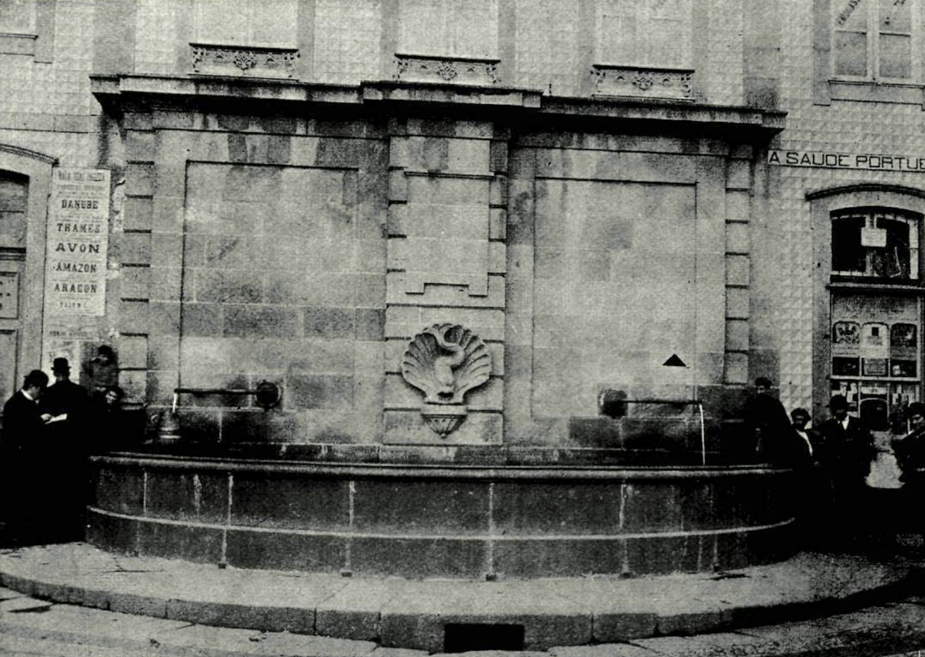
Fonte das Oliveiras in 1908, with the black triangle marking the spout on the right-hand side. AEdP Historical Archive.
CHEMICAL TREATMENT
With the creation of the Municipal Water and Sanitation Services of Porto in 1927, action was taken to prevent contamination of the city's water, starting with the cleaning of the pipes of the reservoirs inherited from the Compagnie and their replacement with iron pipes and the installation of drinking fountains throughout the 20th century. However, it was in 1937 that the chemical treatment of water with chlorine was institutionalized. Until then, the “company water” was water collected from the Sousa River and only filtered in the filtration galleries of the Sousa Plant. These filter galleries were of the “English system,” introduced in London in 1829 by engineer James Simpson of the Chelsea Water Company, and consisted of filter chambers through which water passed through a series of layers of varying thicknesses constructed of materials of increasing size, removing larger sediments.
-
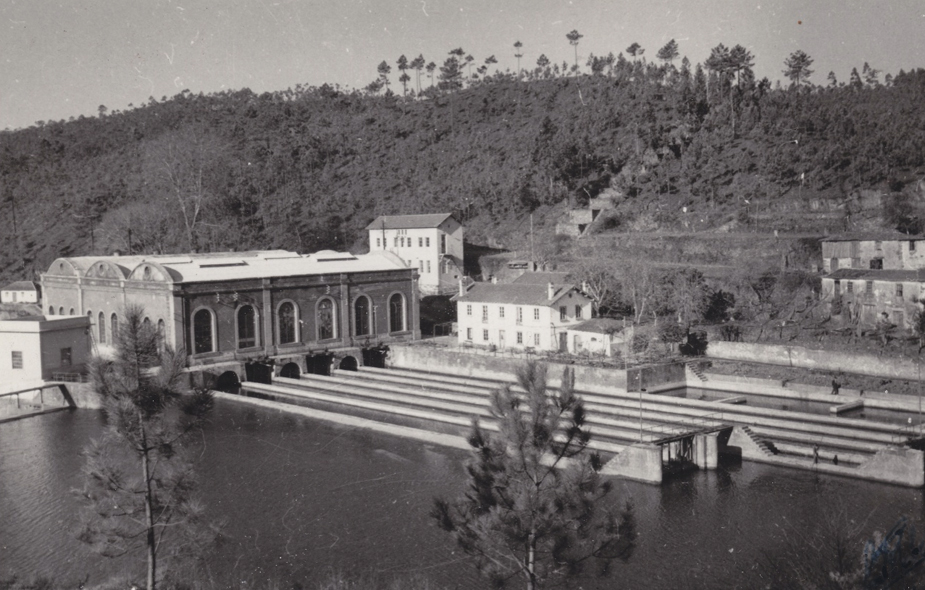
Sousa power station and filter galleries in 1950. AEdP Historical Archive.
This treatment compensated for the inefficiency of the Sousa Plant's filter galleries through chemical treatment. It was carried out at the entrance to the Jovim Tunnel Reservoir, which is still a water treatment plant today. To this end, a small building was constructed next to the entrance chamber, where the preparation tanks were installed, with the mixture being completed in the tunnel and the water main. Next to it, another facility was built to correct any tastes attributed to chlorine. Any excess chlorine was neutralized at the entrance to the city's reservoirs. This new implementation was materialized at the Services headquarters, with the construction of a laboratory to carry out chemical analyses of the water collected at the system's supply points.
-
![Room of the original SMAS laboratory, [undated]. AEdP Historical Archive.](/imagens/galeria/slideshow_137_1.jpg)
Room of the original SMAS laboratory, [undated]. AEdP Historical Archive.
Throughout the 20th century, the construction of municipal-type public wash houses also became widespread, in order to minimize improper washing in watercourses, through structures that promoted hygiene and comfort for washerwomen with the implementation of plumbing, tanks, or individual sinks with running water and spacious enough to allow washerwomen to stand.
CURIOSITY
The original laboratory building at the headquarters of Águas e Energia do Porto was renovated in 2021 with a contemporary architectural design by renowned architect Eduardo Souto de Moura.