
Waterline
PARANHOS WATER ARK
Come take a dive into the history of Arca d'Água!
DID YOU KNOW?
The Paranhos Manancial was the most important in the city due to the quality and quantity of water from its springs. Its springs are located underground at the current Praça 9 de Abril, better known as Jardim da Arca d'Água. The water that springs from underground is a combination of several springs in the area. From there, the water flowed through a stone aqueduct in an underground gallery, feeding several fountains along its route to the city center.
THE MANANCIAL
It is also known as Manancial da Arca d’Água and Manancial das Três Fontes de Paranhos, and it is not known when its water began to be exploited. A fountain in Paranhos is mentioned in 1120, and by the mid-15th century it is known that there were three fountains on the site, which explains its name. In these references, it is likely that the term fonte refers to a spring.
The growing population and lack of water, despite the large number of fountains in Porto in 1594, led to a petition being made to King Sebastian for authorization to bring water from Paranhos to the city center, with the locals agreeing to contribute 1,000 cruzados to the construction costs. Although King Sebastian agreed to the request, it was not until later, during the reign of King Philip I (1527-1598), that the permit allowing the work to proceed was issued, on November 20, 1597. After assessing the feasibility of the work, taking into account the costs and compensation to be paid to the owners of the land that would be crossed by the pipeline, a permit was issued allowing the City Council to pay for the work with the income from the Wine and Salt Tax and the surplus from the growth in excise duties, to which was added the 1,000 cruzados donated by the community. This provision was registered in the chancellery on April 9, 1598.
The first steps of the project were taken in late 1603, with the purchase of the first materials on February 11, 1604. Master masons Pantaleão Brás and Manuel Gonçalves were involved in this work, together with masons Gonçalo Vaz, Gaspar Gonçalves, and António João, with a budget of 3295$700 reis.
The first stone was laid in 1603, accompanied by a solemn ceremony. However, work only began on March 12, 1604, continuing until September 17, 1605. Water from Paranhos reached the city center in mid-1606, at the fountains of São Domingos and Rua Nova.
-
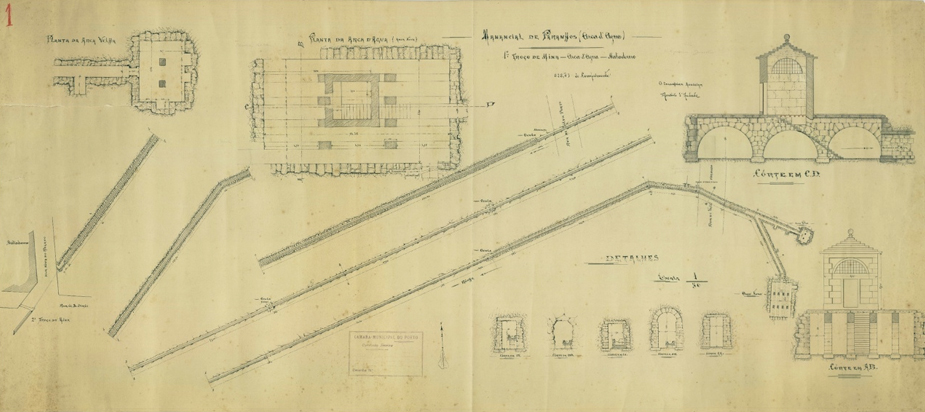
Drawing of the Paranhos Water Reservoir with plans and cross-sections of the Old Reservoir and New Reservoir, 1903 – scales 1:200 and 1:50, AEdP Historical Archive.
-
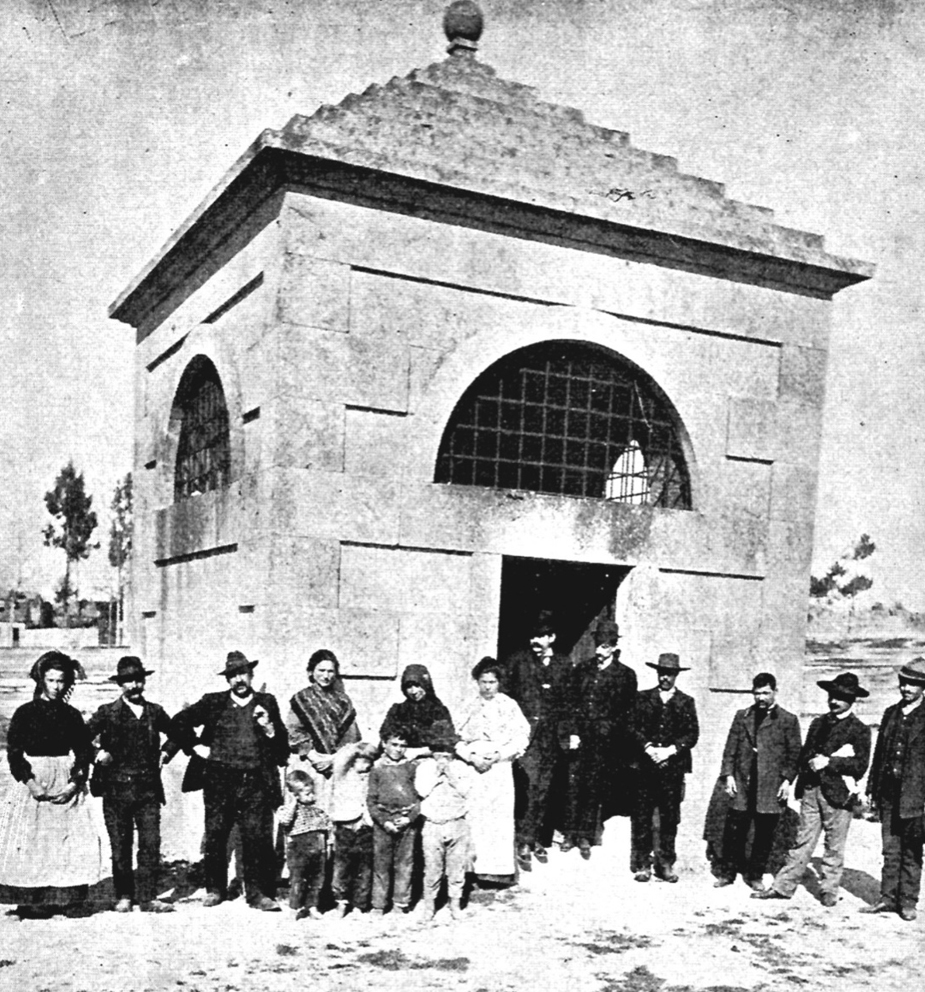
Old Ark providing access to the cistern in 1908. AEdP Historical Archive.
The construction of the water source, known as Arca Velha, and its network of underground galleries, was a major undertaking to ensure water supply to the city and can be considered Porto's first water supply system project. Previously, water was supplied from nearby sources, which explains why the city developed along the riverbank. With the increase in population and growing water consumption, it became necessary to build a gravity-fed water transport network within the walled city. And for the direct supply of the community, and because it was the result of a public initiative, public fountains were built along the route of the underground galleries.
The primitive system was improved over time, with the original layout consisting of an underground route.
MORE WATER
Later, another aqueduct was incorporated into the water supply, which had been under construction since 1789. It came from the Salgueiros Spring, which originated in what is now Rua Antero de Quental, where there were several springs. The waters of Paranhos and Salgueiros reached the Arca do Mercado do Anjo, increasing the flow of water that supplied the city. These waters reached the city on August 7, 1838, and flowed in open channels in the granite, or in iron or lead pipes, inside underground galleries; parts of the route were above ground.
A SECRET
It still exists today, beneath the Jardim da Arca d’Água. Access is via a trapdoor in the ground, from which you descend to the arched structure that protects the springs that make up the Manancial. From there, the water flows through underground aqueducts to the Arca de Sá Noronha, in Praça Gomes Teixeira, opposite the Rectory of the University of Porto, which channels the water to several public fountains.
-
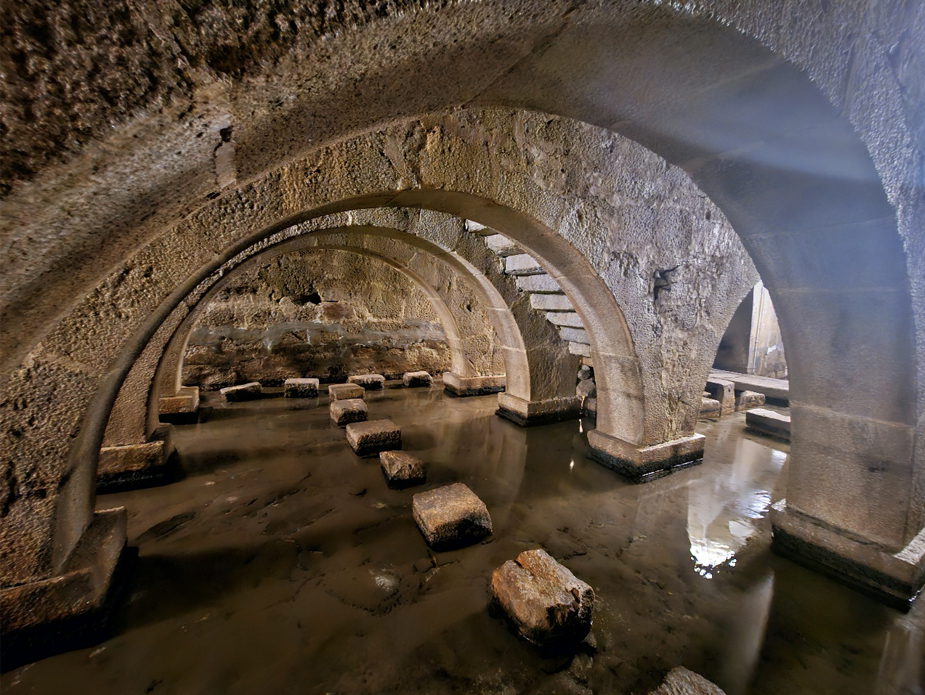
New Ark of the Water Source in 2024.