
Fountains of iron: from community processions to international imagery
To learn more about the Fontes d'Art industry, click here.
With the development of industry in the 19th century, the water supply took advantage of the iron foundry and smelting industry to serve the city with water. At the beginning of the 20th century, small iron fountains supplied by the “Company's water” were installed in public spaces. This phenomenon was motivated by water contamination resulting from industrial and demographic growth, which in turn led to the removal of fountains from the city or the replacement of their water with “company water.” Even so, these fountains were preferable due to their simplicity of maintenance, but also because they constituted a minor obstacle to the city's built growth.
Although the industrial home supply system began operating at full capacity in 1887, it took time for the “Company water” to reach the taps of all Porto residents. The democratization of access to good quality water was made possible by these fountains, which were cheap to produce and easy to install, thus allowing for an increase in the number of water points in the city, which gradually spread to the suburbs.
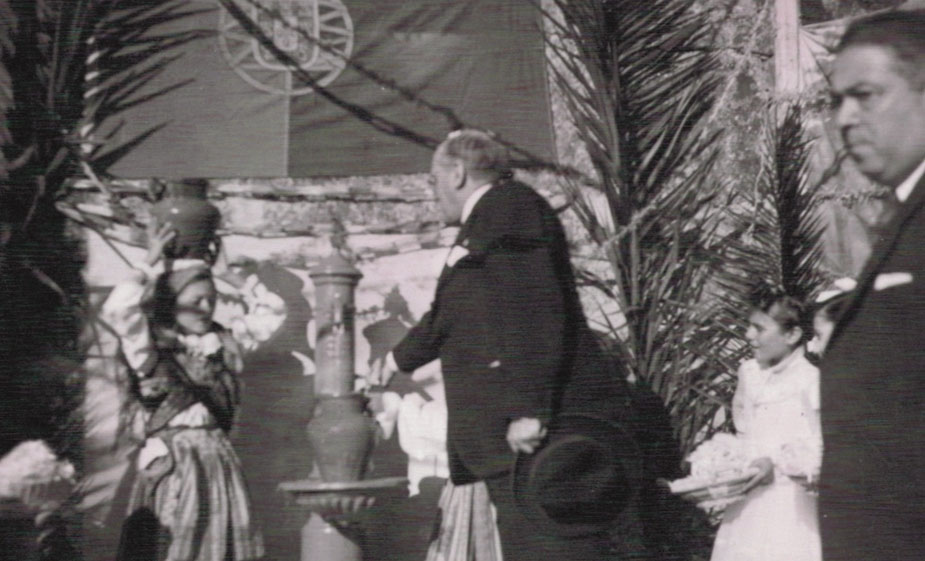
Inauguration ceremony for a fountain in Pego Negro (Foz) on November 15, 1953.
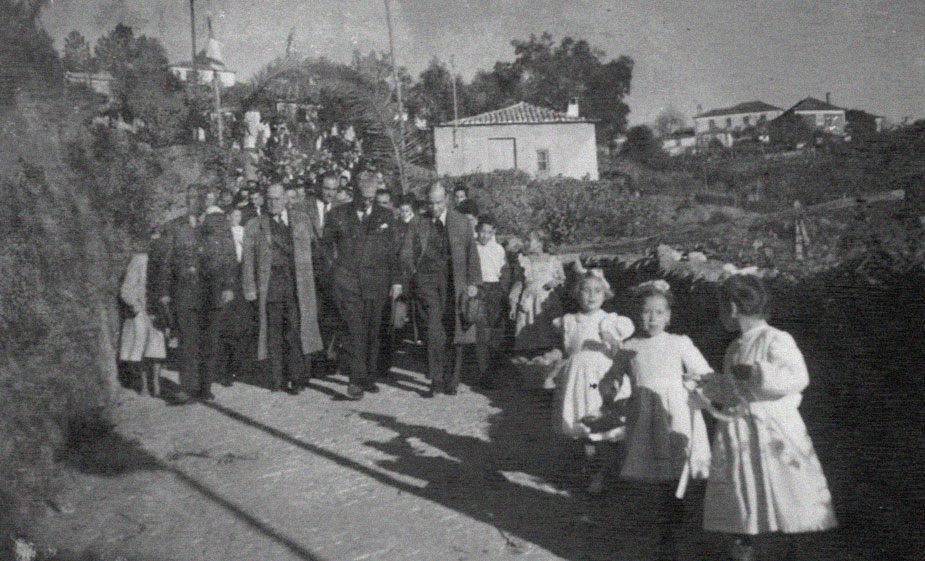
Inauguration ceremony for a fountain in Zebreiros (Gondomar) on November 14, 1954.
Iron fountains appeared in Porto at the height of this industry's development in the 19th century. These elements of urban furniture became widespread internationally during this period, and some examples have survived to this day. The examples of Fontes d'Art are the Fonte dos Leões, the Fonte do Mercado Ferreira Borges, the Fonte da Quinta de São Roque da Lameira, and the fountains in the Jardins do Palácio de Cristal.
To learn more about the history of the Fonte dos Leões, click here.
These models found in Porto are Fontes d'Art models from the most emblematic foundry in French industry, Val d'Osne, created in 1836. The exception is the model of the fountains in the Jardins do Palácio de Cristal, which is from Ducel Fonderie, created in 1823 and purchased in 1878 by its rival, Val d'Osne. The model for these fountains was exhibited at the 1867 Universal Exhibition in Paris.
With the development of industry in the 19th century, the water supply took advantage of the iron foundry and smelting industry to serve the city with water. At the beginning of the 20th century, small iron fountains supplied by the “Company's water” were installed in public spaces. This phenomenon was motivated by water contamination resulting from industrial and demographic growth, which in turn led to the removal of fountains from the city or the replacement of their water with “company water.” Even so, these fountains were preferable due to their simplicity of maintenance, but also because they constituted a minor obstacle to the city's built growth.
Although the industrial home supply system began operating at full capacity in 1887, it took time for the “Company water” to reach the taps of all Porto residents. The democratization of access to good quality water was made possible by these fountains, which were cheap to produce and easy to install, thus allowing for an increase in the number of water points in the city, which gradually spread to the suburbs.
Inauguration ceremony for a fountain in Pego Negro (Foz) on November 15, 1953.
Inauguration ceremony for a fountain in Zebreiros (Gondomar) on November 14, 1954.
Iron fountains appeared in Porto at the height of this industry's development in the 19th century. These elements of urban furniture became widespread internationally during this period, and some examples have survived to this day. The examples of Fontes d'Art are the Fonte dos Leões, the Fonte do Mercado Ferreira Borges, the Fonte da Quinta de São Roque da Lameira, and the fountains in the Jardins do Palácio de Cristal.
To learn more about the history of the Fonte dos Leões, click here.
These models found in Porto are Fontes d'Art models from the most emblematic foundry in French industry, Val d'Osne, created in 1836. The exception is the model of the fountains in the Jardins do Palácio de Cristal, which is from Ducel Fonderie, created in 1823 and purchased in 1878 by its rival, Val d'Osne. The model for these fountains was exhibited at the 1867 Universal Exhibition in Paris.