
Fonte da Praça da Ribeira, from medieval to contemporary
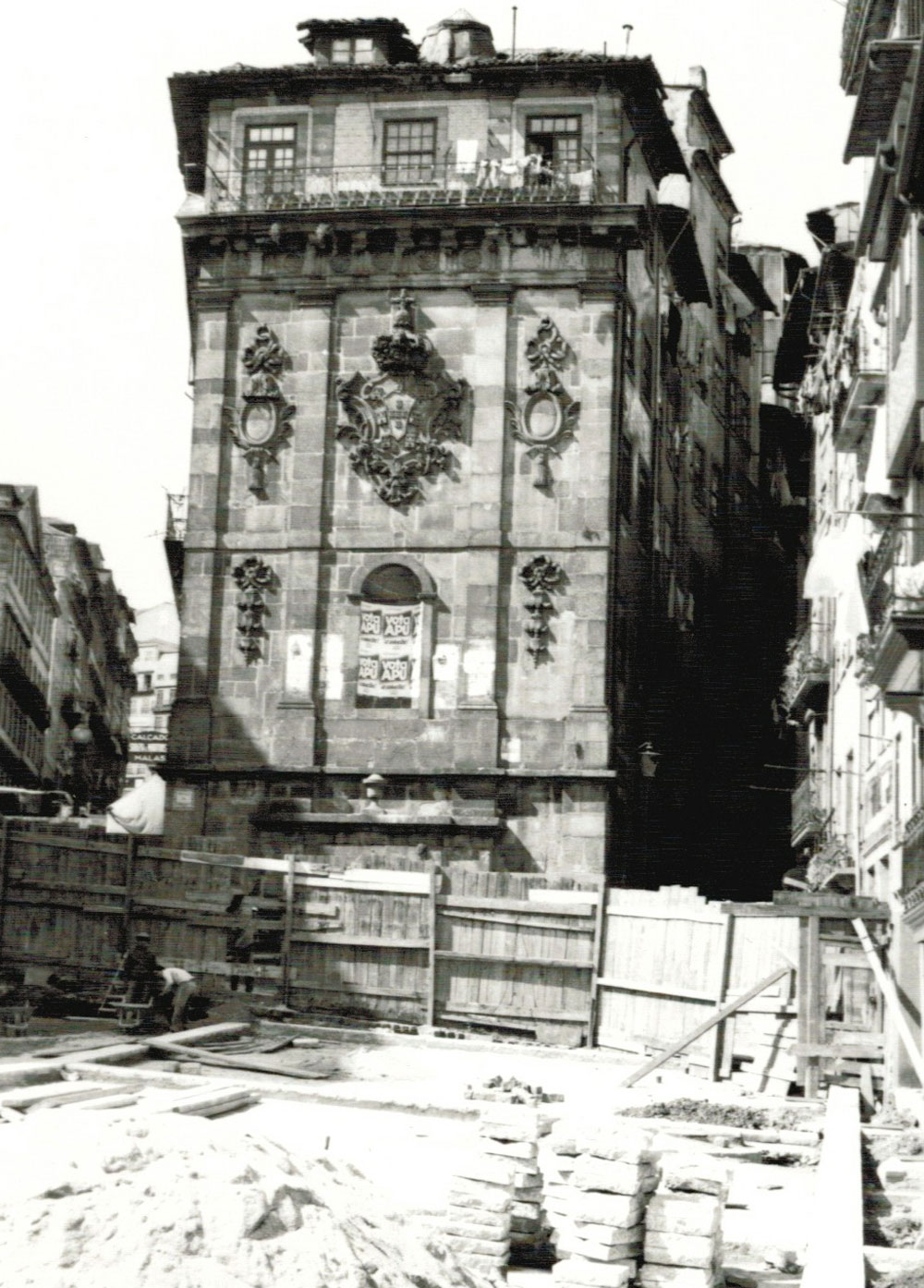
Archaeological excavations in the 1980s revealed elements of the old fountain in the square, which were used in the contemporary work.
The Fonte da Ribeira (Ribeira Fountain) dates back to the 18th century, inheriting the role of water supply point in the square from a 17th-century fountain. This fountain survives, interpreted from the stones of its tank, in the work “O Cubo” (The Cube) by José Rodrigues, dated 1983. The cut-out design of the basin reflects a Baroque taste, which tells us that the fountain would have been a prominent ornamental element in the square. In 1980, the site was the subject of an archaeological excavation by Armando Coelho Ferreira da Silva. The remains of the old fountain were found about one meter below Praça da Ribeira, in the center of the square.
The existence of a water fountain in the square is transversal to the history of the square. Although it has not always had its current configuration, it has always been a point of convergence.
Praça da Ribeira dates back to the 17th century and developed in association with the medieval square, performing customs functions since the city's origins, with the arrival of merchant ships, commercial functions through the Ribeira quay, and fishing functions, due to its proximity to the Douro River. These functions are immortalized by Rua dos Mercadores, which flanks the fountain, were it not for the square next to one of the entrance gates to the city's Fernandine wall, Porta da Ribeira. Later, with the opening of the axis connecting it to the upper part of the city, Rua de São João, which also names the Ribeira Fountain as São João Fountain, it was given its current configuration. Its layout, which opens onto the river, underwent a renovation promoted by the Public Works Board during the Almada period, giving it a modern look, evident in the uniformity of the facades with arcaded porticos. Its architecture reflects the typology of the “dos almadas” public fountain, a period characterized by the construction of fountains with a backrest, usually leaning against or attached to a wall or building, responding to the city's modernization precepts based on the enhancement of public space and wide streets, favoring circulation, in accordance with the Enlightenment ideals of the time.
It is part of the Historic Center of Porto, which was classified as a World Heritage Site by UNESCO in 1996.
To learn more about the Almadinas fountains, click here.
The Fonte da Ribeira (Ribeira Fountain) dates back to the 18th century, inheriting the role of water supply point in the square from a 17th-century fountain. This fountain survives, interpreted from the stones of its tank, in the work “O Cubo” (The Cube) by José Rodrigues, dated 1983. The cut-out design of the basin reflects a Baroque taste, which tells us that the fountain would have been a prominent ornamental element in the square. In 1980, the site was the subject of an archaeological excavation by Armando Coelho Ferreira da Silva. The remains of the old fountain were found about one meter below Praça da Ribeira, in the center of the square.
The existence of a water fountain in the square is transversal to the history of the square. Although it has not always had its current configuration, it has always been a point of convergence.
Praça da Ribeira dates back to the 17th century and developed in association with the medieval square, performing customs functions since the city's origins, with the arrival of merchant ships, commercial functions through the Ribeira quay, and fishing functions, due to its proximity to the Douro River. These functions are immortalized by Rua dos Mercadores, which flanks the fountain, were it not for the square next to one of the entrance gates to the city's Fernandine wall, Porta da Ribeira. Later, with the opening of the axis connecting it to the upper part of the city, Rua de São João, which also names the Ribeira Fountain as São João Fountain, it was given its current configuration. Its layout, which opens onto the river, underwent a renovation promoted by the Public Works Board during the Almada period, giving it a modern look, evident in the uniformity of the facades with arcaded porticos. Its architecture reflects the typology of the “dos almadas” public fountain, a period characterized by the construction of fountains with a backrest, usually leaning against or attached to a wall or building, responding to the city's modernization precepts based on the enhancement of public space and wide streets, favoring circulation, in accordance with the Enlightenment ideals of the time.
It is part of the Historic Center of Porto, which was classified as a World Heritage Site by UNESCO in 1996.
To learn more about the Almadinas fountains, click here.