
A Fonte Monumental, which never was the Lions'
The domestic water supply system also brought to the city a fountain produced in Paris and installed in the former Praça dos Voluntários da Rainha, now Praça de Gomes Teixeira, or as it is commonly known, Praça dos Leões. A product of an industry that combines practicality with aesthetics, art, and industry, the “fonte d'art” industry, the Monumental Fountain reflects this very fact: in addition to functioning as an ornament in public spaces, due to its sculptural composition and water features, it also performed technical functions. The fountain connected to the main pipeline that came from the Santo Isidro Reservoir, i.e., the pipeline that supplied the middle zone (city center), and the pipeline that supplied the lower zone of the city (riverfront) and the São João da Foz Reservoir (now the Reservoir - Museum of Porto). It thus functioned as a meeting point that was essential for oxygenating and regulating water pressure, given the great length of the pipeline connecting the two reservoirs and the two areas of the city. In addition, a set of underground valves located in the control chamber made it possible to cut off the flow of water from one of the reservoir pipes in cases of emergency or maintenance and intervention.
To learn more about the first industrial domestic water supply system, click here.
The 1867 Universal Exhibition in Paris was the first to establish the artistic casting industry, or fonte d’art, with an exhibition of cast iron artifacts from the Val d’Osne foundry. Here, for the first time, there was a specific category of “Bronzes d’art, Fontes d’arts diverses, objets en metaux repoussés.” The year 1878 saw the consecration of the fonte d'art industry in the field of urban beautification. Most of the pieces in Portugal were manufactured by the Val d'Osne foundry and the Durenne foundry, the most emblematic in Paris and responsible for spreading this industry internationally through their catalogs.
In the case of Portugal, we can understand the 1865 Universal Exhibition, held in Porto, as the one that highlighted the impact of urban artifacts on urban planning. Examples of fonte d'art from French foundries can be found in the gardens of the Crystal Palace, brought from Paris to embellish the gardens for the exhibition, but also the Fonte do Mercado Ferreira Borges, with allegories to fauna and flora, currently also installed in the Crystal Palace Gardens and produced by the Val d'Osne foundry, as is the Fonte dos Leões.
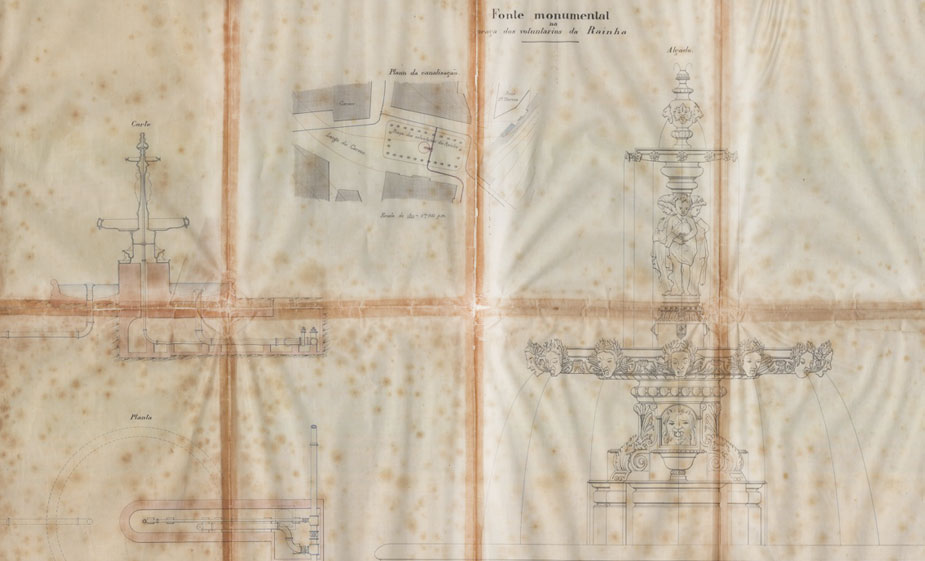
Original design for the Fonte Monumental, 1883.
The original design for the Fonte Monumental presented by the Compagnie to the Porto City Council in 1883 was a model from the catalog of one of Paris' most iconic foundries, the Durenne Foundry. The model is from the “Durenne Fontaines” catalog and featured two bowls and a more detailed decorative program. The project was rejected by the City Council and a new fountain model from the Val d'Osne Foundry was approved, belonging to the foundry's most widely distributed catalog, No. 2, dedicated to Fontes d'Art, published in 1881, in the “Animaux” section.
One of the characteristics of 19th-century street furniture is that it was manufactured in molds, democratizing it, in a way, through its affordable price and the dissemination of the artifacts and their forms through catalogs. For this reason, we find several artifacts with the “lion” element that we find in the Fonte dos Leões, both nationally and internationally, produced by the same French foundry. The fountain in Jorge I Square in Patras, Greece, from 1875, the one at Leicester Town Hall in Leicester, manufactured in 1878, and the sculptural elements of the fountain on Avenida da Liberdade in Lisbon, from 1879-1886. Were it not for the fact that this “lion” is part of catalog album No. 2, considered the best known and most complete album dedicated to the art fountains of Val d'Osne, where it is described as a “griffin.” Could it be that the Fonte Monumental was never about lions, but griffins?
To learn more about the first industrial domestic water supply system, click here.
The 1867 Universal Exhibition in Paris was the first to establish the artistic casting industry, or fonte d’art, with an exhibition of cast iron artifacts from the Val d’Osne foundry. Here, for the first time, there was a specific category of “Bronzes d’art, Fontes d’arts diverses, objets en metaux repoussés.” The year 1878 saw the consecration of the fonte d'art industry in the field of urban beautification. Most of the pieces in Portugal were manufactured by the Val d'Osne foundry and the Durenne foundry, the most emblematic in Paris and responsible for spreading this industry internationally through their catalogs.
In the case of Portugal, we can understand the 1865 Universal Exhibition, held in Porto, as the one that highlighted the impact of urban artifacts on urban planning. Examples of fonte d'art from French foundries can be found in the gardens of the Crystal Palace, brought from Paris to embellish the gardens for the exhibition, but also the Fonte do Mercado Ferreira Borges, with allegories to fauna and flora, currently also installed in the Crystal Palace Gardens and produced by the Val d'Osne foundry, as is the Fonte dos Leões.
Original design for the Fonte Monumental, 1883.
The original design for the Fonte Monumental presented by the Compagnie to the Porto City Council in 1883 was a model from the catalog of one of Paris' most iconic foundries, the Durenne Foundry. The model is from the “Durenne Fontaines” catalog and featured two bowls and a more detailed decorative program. The project was rejected by the City Council and a new fountain model from the Val d'Osne Foundry was approved, belonging to the foundry's most widely distributed catalog, No. 2, dedicated to Fontes d'Art, published in 1881, in the “Animaux” section.
One of the characteristics of 19th-century street furniture is that it was manufactured in molds, democratizing it, in a way, through its affordable price and the dissemination of the artifacts and their forms through catalogs. For this reason, we find several artifacts with the “lion” element that we find in the Fonte dos Leões, both nationally and internationally, produced by the same French foundry. The fountain in Jorge I Square in Patras, Greece, from 1875, the one at Leicester Town Hall in Leicester, manufactured in 1878, and the sculptural elements of the fountain on Avenida da Liberdade in Lisbon, from 1879-1886. Were it not for the fact that this “lion” is part of catalog album No. 2, considered the best known and most complete album dedicated to the art fountains of Val d'Osne, where it is described as a “griffin.” Could it be that the Fonte Monumental was never about lions, but griffins?